


3 myths about Australia Light Horse charge at Beersheba

Updated: Jun 20
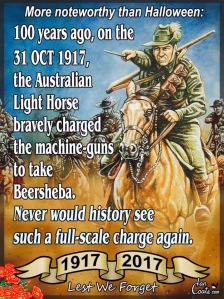
In my unpublished book, Beersheba: the untold story of how three myths, two units, and one charge captured our imagination, I go into a lot more depth about the myths that continue to perpetuated about the Australia Light Horse charge at Beersheba, but the media coverage about today’s centenary of the charge is getting my goat, so I wanted to summarise my thoughts in this blog post.
First, I’m not surprised Paul Daley has penned an article claiming that the Battle of Beersheba is only getting it’s moment in the sun because of the ‘politics of remembrance’. Although I dispute his premise that Beersheba was ever forgotten — as reviews of his book pointed out, how can an event that’s produced two movies claim to be ‘forgotten’ — I agree with his general point that there are many perspectives on history. And his article does provide a good general overview of the many operational moving parts leading up to the 3rd Battle of Gaza, which the Battle of Beersheba was actually the preliminary operation for.
A glimpse of the myths I explore in my manuscript are:
Myth One: Taking Beersheba was a fluke
In the mythologising of the charge, the ‘vibe’ is that Australians were innate, natural soldiers. Yet, most of those who charged had been at Gallipoli, and some were Boer War veterans. And for those who hadn’t been there or weren’t veterans of earlier conflicts, such as the Reinforcements, there was initial and ongoing training ‘in-country’ for them and their horses, which meant they weren’t expected to simply ‘know’ how to ‘soldier’. And that’s before we go into the debate about whether they were light cavalry, mounted rifles, or mounted infantry.
Myth Two: Taking Beersheba was about the water
You’ve probably heard in the media coverage that the charge was because the horses needed water, that they ‘sniffed it in their nostrils’. Even Daley doesn’t buy this; in his article he summarises the months of preparation that went into ensuring there was water available for the Battle of Beersheba. In fact, due to the lack of water in Beersheba (which they’d anticipated to a degree), operations to attack Gaza were set back a week, as the most of the forces had to retrace their steps many kilometres so as re-water before the bulk of the force could advance from Beersheba to Gaza.
Myth Three: Taking Beersheba helped win the war
This is the biggest myth that continues to be perpetuated, even in the current media coverage. Daley also points out that Beersheba was part of the third attempt to take the city of Gaza. Put simply, from my perspective, if the charge — as part of an entire day of military operations to capture the town of Beersheba — helped win the war … why did it take another year for the Armistice of Mudros to be signed?
~~~~
* This image of an Ian Coate artwork is doing the rounds again on social media … I only share it here to illustrate how the last line also perpetuates a myth (albeit carefully worded to try and refute claims that it continues the myth) … that ‘never would history see such a full-scale charge again’ … when Wikipedia has a reasonable list of notable charges throughout history, and does include the Australia Light Horse charge at Beersheba (though it doesn’t include when the US Special Forces took horses into Afghanistan in 2001).
~~~~
Obviously this is barely a sample of the detail explored in my manuscript, which I’ll be self-publishing in coming months. But if you’re interested in why my book’s not out for today’s commemoration activities, please refer to my other blog posts:


Comments